











Chroma Releases Context-1: A 20B Agentic Search Model for Multi-Hop Retrieval, Context Management, and Scalable Synthetic Task Generation

In the current AI landscape, the ‘context window’ has become a blunt instrument. We’ve been told that if we simply expand the memory of a frontier model, the retrieval problem disappears. But as any AI professionals building RAG (Retrieval-Augmented Generation) systems knows, stuffing a million tokens into a prompt often leads to higher latency, astronomical costs, and a ‘lost in the middle’ reasoning failure that no amount of compute seems to fully solve.
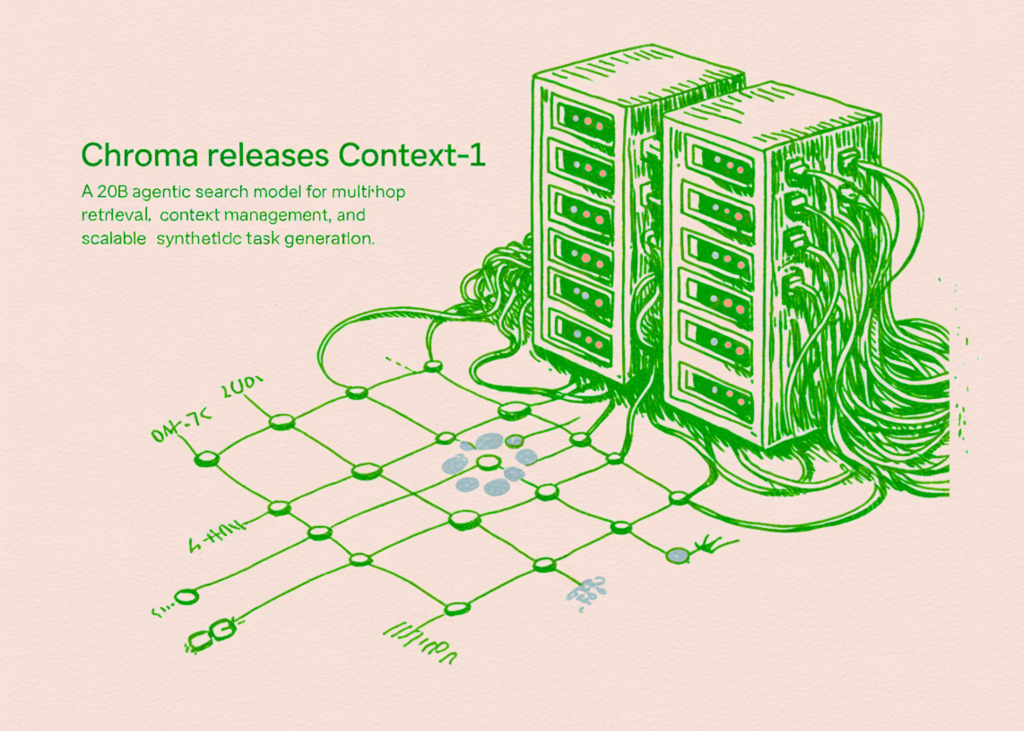
Chroma, the company behind the popular open-source vector database, is taking a different, more surgical approach. They released Context-1, a 20B parameter agentic search model designed to act as a specialized retrieval subagent.
Rather than trying to be a general-purpose reasoning engine, Context-1 is a highly optimized ‘scout.’ It is built to do one thing: find the right supporting documents for complex, multi-hop queries and hand them off to a downstream frontier model for the final answer.
The Rise of the Agentic Subagent
Context-1 is derived from gpt-oss-20B, a Mixture of Experts (MoE) architecture that Chroma has fine-tuned using a combination of Supervised Fine-Tuning (SFT) and Reinforcement Learning (RL) via CISPO (a staged curriculum optimization).
The goal isn’t just to retrieve chunks; it’s to execute a sequential reasoning task. When a user asks a complex question, Context-1 doesn’t just hit a vector index once. It decomposes the high-level query into targeted subqueries, executes parallel tool calls (averaging 2.56 calls per turn), and iteratively searches the corpus.
For AI professionals, the architectural shift here is the most important takeaway: Decoupling Search from Generation. In a traditional RAG pipeline, the developer manages the retrieval logic. With Context-1, that responsibility is shifted to the model itself. It operates inside a specific agent harness that allows it to interact with tools like search_corpus (hybrid BM25 + dense search), grep_corpus (regex), and read_document.
The Killer Feature: Self-Editing Context
The most technically significant innovation in Context-1 is Self-Editing Context.
As an agent gathers information over multiple turns, its context window fills up with documents—many of which turn out to be redundant or irrelevant to the final answer. General models eventually ‘choke’ on this noise. Context-1, however, has been trained with a pruning accuracy of 0.94.
Mid-search, the model reviews its accumulated context and proactively executes a prune_chunks command to discard irrelevant passages. This ‘soft limit pruning’ keeps the context window lean, freeing up capacity for deeper exploration and preventing the ‘context rot’ that plagues longer reasoning chains. This allows a specialized 20B model to maintain high retrieval quality within a bounded 32k context, even when navigating datasets that would typically require much larger windows.
Building the ‘Leak-Proof’ Benchmark: context-1-data-gen
To train and evaluate a model on multi-hop reasoning, you need data where the ‘ground truth’ is known and requires multiple steps to reach. Chroma has open-sourced the tool they used to solve this: the context-1-data-gen repository.
The pipeline avoids the pitfalls of static benchmarks by generating synthetic multi-hop tasks across four specific domains:
- Web: Multi-step research tasks from the open web.
- SEC: Finance tasks involving SEC filings (10-K, 20-F).
- Patents: Legal tasks focusing on USPTO prior-art search.
- Email: Search tasks using the Epstein files and Enron corpus.
The data generation follows a rigorous Explore → Verify → Distract → Index pattern. It generates ‘clues’ and ‘questions’ where the answer can only be found by bridging information across multiple documents. By mining ‘topical distractors’—documents that look relevant but are logically useless—Chroma ensures that the model cannot ‘hallucinate’ its way to a correct answer through simple keyword matching.
Performance: Faster, Cheaper, and Competitive with GPT-5
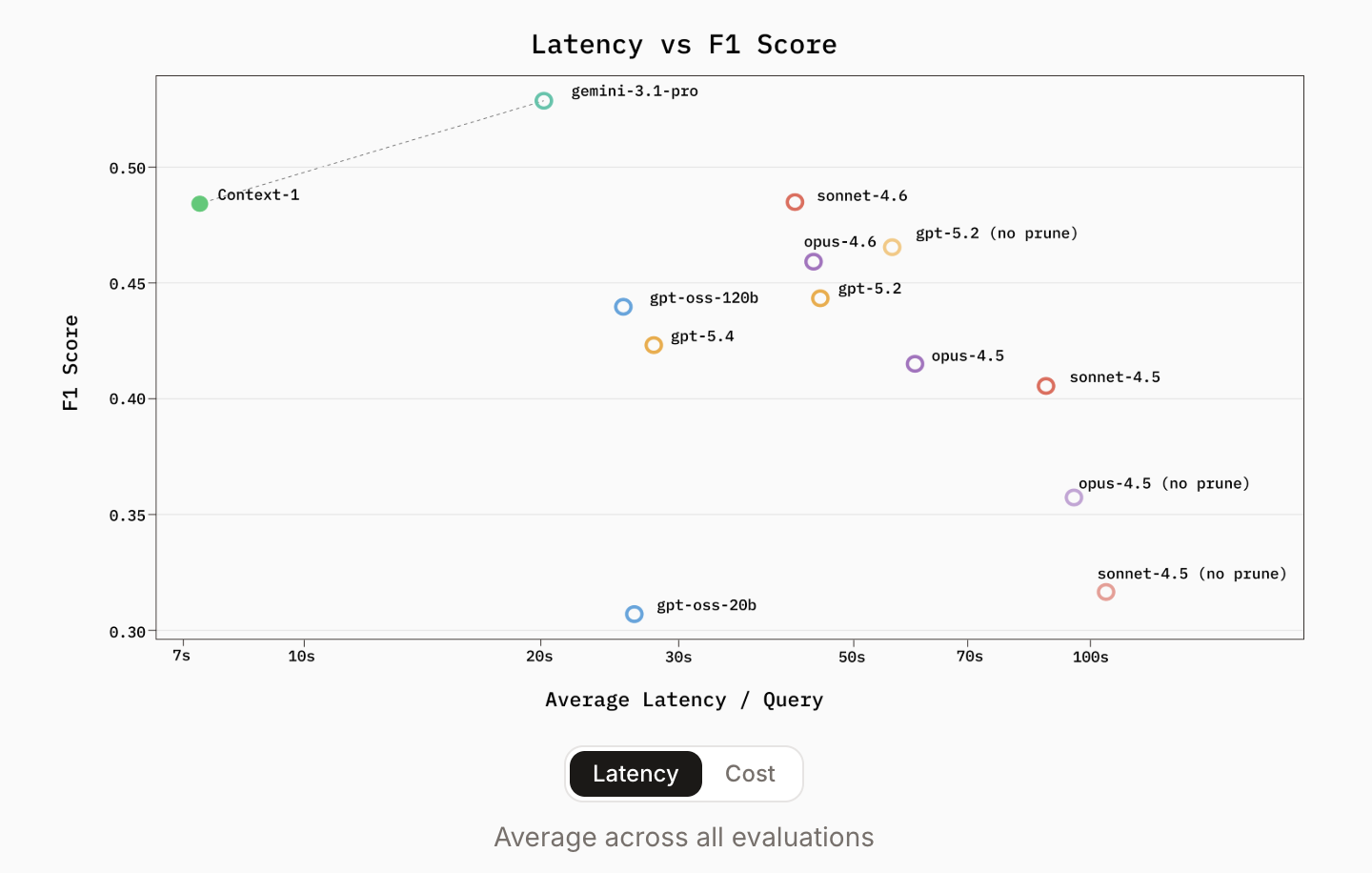
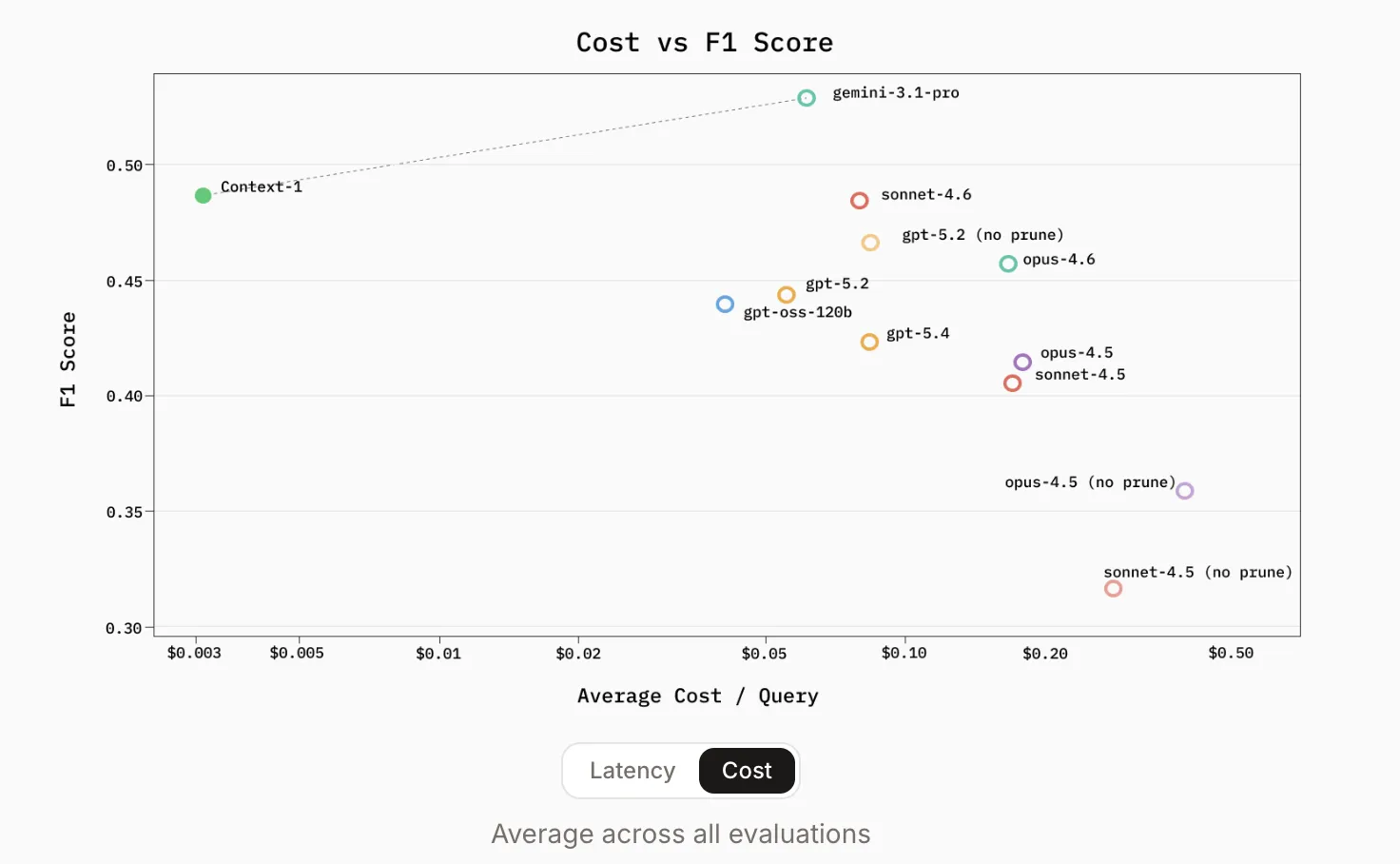
The benchmark results released by Chroma are a reality check for the ‘frontier-only’ crowd. Context-1 was evaluated against 2026-era heavyweights including gpt-oss-120b, gpt-5.2, gpt-5.4, and the Sonnet/Opus 4.5 and 4.6 families.
Across public benchmarks like BrowseComp-Plus, SealQA, FRAMES, and HotpotQA, Context-1 demonstrated retrieval performance comparable to frontier models that are orders of magnitude larger.
The most compelling metrics for AI devs are the efficiency gains:
- Speed: Context-1 offers up to 10x faster inference than general-purpose frontier models.
- Cost: It is approximately 25x cheaper to run for the same retrieval tasks.
- Pareto Frontier: By using a ‘4x’ configuration—running four Context-1 agents in parallel and merging results via reciprocal rank fusion—it matches the accuracy of a single GPT-5.4 run at a fraction of the compute.
The ‘performance cliff’ identified isn’t about token length alone; it’s about hop-count. As the number of reasoning steps increases, general models often fail to sustain the search trajectory. Context-1’s specialized training allows it to navigate these deeper chains more reliably because it isn’t distracted by the ‘answering’ task until the search is concluded.
Key Takeaways
- The ‘Scout’ Model Strategy: Context-1 is a specialized 20B parameter agentic search model (derived from gpt-oss-20B) designed to act as a retrieval subagent, proving that a lean, specialized model can outperform massive general-purpose LLMs in multi-hop search.
- Self-Editing Context: To solve the problem of ‘context rot,’ the model features a pruning accuracy of 0.94, allowing it to proactively discard irrelevant documents mid-search to keep its context window focused and high-signal.
- Leak-Proof Benchmarking: The open-sourced context-1-data-gen tool uses a synthetic ‘Explore → Verify → Distract’ pipeline to create multi-hop tasks in Web, SEC, Patent, and Email domains, ensuring models are tested on reasoning rather than memorized data.
- Decoupled Efficiency: By focusing solely on retrieval, Context-1 achieves 10x faster inference and 25x lower costs than frontier models like GPT-5.4, while matching their accuracy on complex benchmarks like HotpotQA and FRAMES.
- The Tiered RAG Future: This release champions a tiered architecture where a high-speed subagent curates a ‘golden context’ for a downstream frontier model, effectively solving the latency and reasoning failures of massive, unmanaged context windows.
Check out the Repo and Technical details. Also, feel free to follow us on Twitter and don’t forget to join our 120k+ ML SubReddit and Subscribe to our Newsletter. Wait! are you on telegram? now you can join us on telegram as well.


